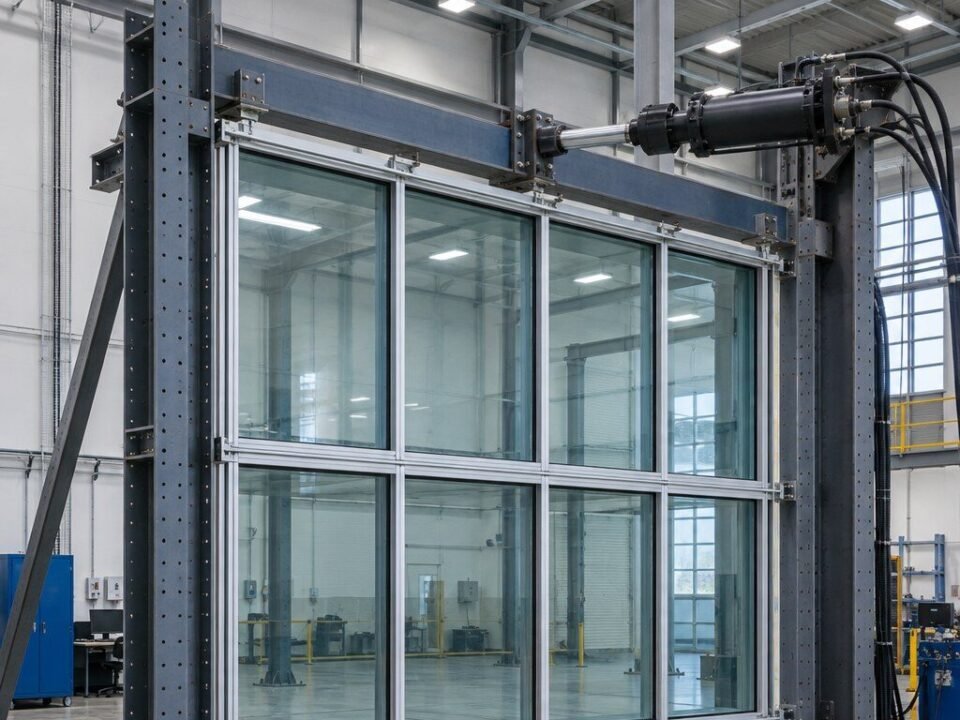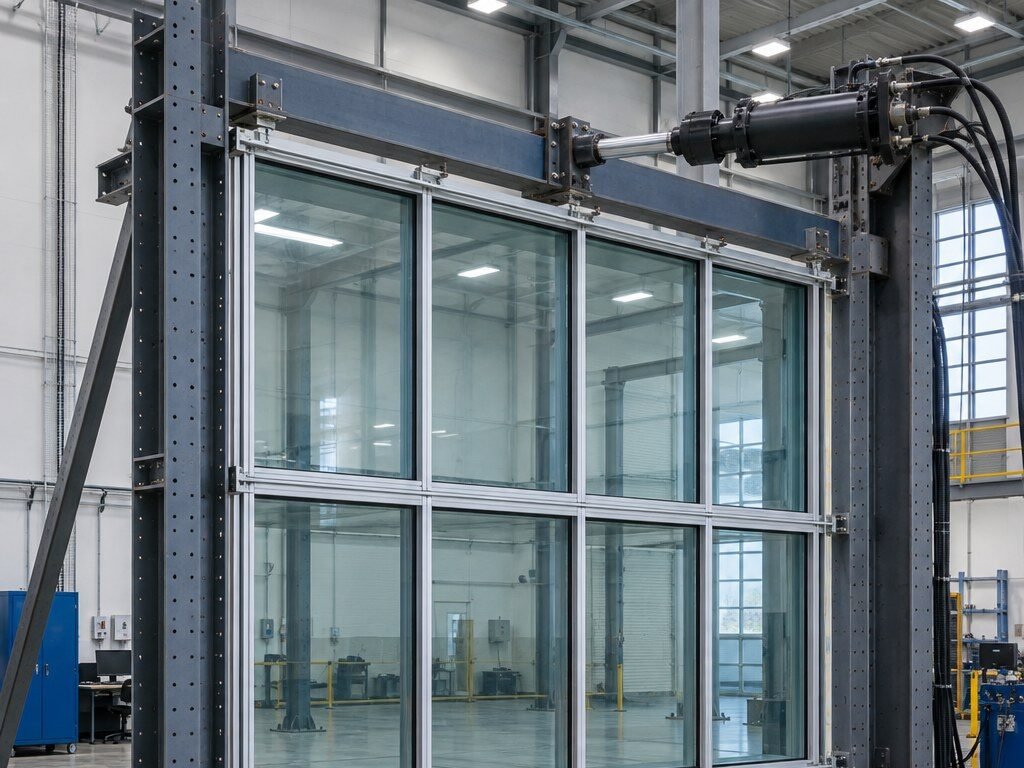

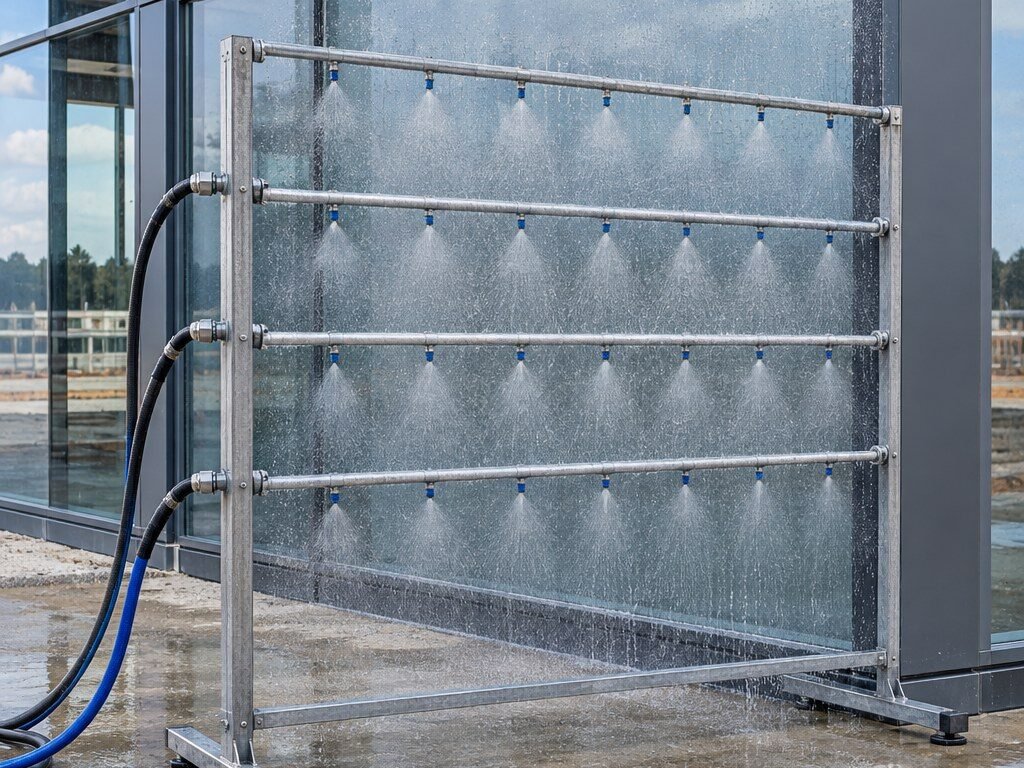
ASTM E1105-26 is now listed as the active edition of the field water-penetration test method for installed curtain walls, windows, skylights and doors. ASTM’s catalogue shows an update date of October 22, 2026. For Canadian façade teams, the news is a timely reminder that a water test should be selected for its purpose—not simply because a familiar standard number appears in a specification.
There are three different questions to answer: Does a completed installation resist water under a specified pressure difference? Can a localized leak be investigated? Does a laboratory specimen meet its design-performance target? The appropriate procedure and acceptance criteria are not necessarily the same.
What is new in October 2026?
ASTM International lists E1105-26 as the active standard for field determination of water penetration of installed exterior windows, skylights, doors and curtain walls under uniform or cyclic static air-pressure differences. The catalogue shows October 22, 2026 as its latest update. The previous listing was ASTM E1105-15(2023).
Important distinction: the publicly available scope confirms the new edition and the test’s general purpose, but it does not establish which technical clauses changed between editions. Project teams should obtain the controlled document, review the revisions and confirm which edition the contract requires. It would be premature to claim that E1105-26 changes spray rates, test pressures or pass/fail limits without reviewing the full standard.
ASTM E1105: field water penetration under pressure
ASTM E1105 addresses installed assemblies. Water is applied to the exterior face and exposed edges while an air-pressure difference is imposed across the test area. Depending on the specified procedure, the pressure may be uniform or cyclic. The objective is to assess resistance to water penetration at a defined test condition, not to reproduce every wind-driven rain event that a building might experience.
ASTM specifically notes that laboratory performance can differ from field performance because of supporting structure, installation, handling, adjacent trades, aging and environmental exposure. It also observes that testing early—before interior finishes conceal the assembly—can make leakage easier to detect and corrective work less expensive. These are practical reasons to plan field testing before façade installation is nearly complete.
For a meaningful test, the project documents should identify the selected specimen or bay, applicable edition, pressure differential, test procedure, duration, access conditions, observations and acceptance criteria. The standard provides the method; the project specification and authority responsible for acceptance must establish the required performance.
AAMA 501.2-25: a different kind of field check
AAMA 501.2-25, published by the Fenestration and Glazing Industry Alliance (FGIA), is titled Quality Assurance and Diagnostic Water Leakage Field Check of Installed Storefronts, Curtain Walls and Sloped Glazing Systems. FGIA describes its purpose as a quality-assurance and diagnostic check of installed systems, particularly the joints, gaskets and sealant details intended to remain permanently closed and watertight.
That is a different question from demonstrating performance at a specified air-pressure differential. A diagnostic check can help isolate a suspect joint or installation detail, but it should not automatically be treated as equivalent to a pressure-based ASTM E1105 test. Similarly, passing a diagnostic check does not establish every performance requirement of a curtain wall system.
FGIA identifies the 2025 edition as active. Its 2025 update also clarified which fixed fenestration products are included or excluded. The specific procedure, coverage and limitations should be confirmed from the purchased document rather than inferred from a project team’s previous experience with an older edition.
Where do ASTM E331 and AAMA 503 fit?
ASTM E331-00(2023) is a water-penetration method using a uniform static air-pressure difference and is widely relevant to evaluation of exterior windows, curtain walls, skylights and doors. Its laboratory-style use is distinct from testing an already installed assembly under ASTM E1105. Test results are not interchangeable without considering specimen configuration, mounting, exposure and acceptance criteria.
AAMA 503-24 is another relevant FGIA document: a voluntary specification for field testing newly installed storefronts, curtain walls and sloped glazing systems. It addresses installed-performance evaluation and helps organize field-testing requirements. When a project cites both a test method and a specification, the team should determine how the documents work together rather than selecting one in isolation.
A practical Canadian façade testing plan
1. Start with the performance question
Is the goal a contractual acceptance test, quality-control screening during installation, or investigation of a reported leak? Write the purpose down before selecting the procedure. A leak investigation may begin with targeted observation and a diagnostic check, while contractual verification may require a pressure-based method.
2. Define the representative locations
Consider transitions that are difficult to replicate in a simple mock-up: perimeter seals, slab-edge interfaces, corners, mullion intersections, unit-to-unit joints and connections to adjacent cladding. Selection should reflect the project’s exposure and construction details, not only the easiest accessible bay.
3. Make access and observation possible
Arrange safe access, coordinate with the contractor and testing laboratory, and avoid concealing critical interfaces before observations are complete. ASTM cautions that finished curtain walls can be difficult to inspect from inside, particularly near spandrels and concealed surfaces.
4. Document what a result actually proves
Record the standard and edition, equipment setup, test location, weather, specified pressure where applicable, observations, any leakage path identified, corrective work and retest scope. Distinguish no observed leakage under the stated test conditions from a broad claim that the whole building envelope is waterproof.
5. Close the feedback loop
When leakage is found, identify whether the likely issue concerns fabrication, installation, movement accommodation, drainage, sealing or an interface with another trade. Repair and retest the affected detail as appropriate, then share the lesson with crews working on similar elevations. A useful test program improves construction quality; it is not merely a box to check at turnover.
What should Canadian specifiers do now?
Review live project specifications for edition references, especially where older ASTM E1105 citations are carried forward. Confirm whether the contract intentionally freezes an earlier edition or permits the latest one. Verify the adopted code, project-specific requirements and procurement documents before changing acceptance criteria. The existence of a newer ASTM edition does not by itself amend a signed contract or a provincial building-code requirement.
For project planning, keep the Curtainwall.ca resources and façade project inquiry checklist handy when defining scope, and use the industry directory to identify relevant categories of consultants, contractors and laboratories. This article is general educational information, not a project-specific test specification or engineering opinion.