
Why the laboratory’s scope matters
A curtain wall test report can be technically credible and still fail to answer a project’s procurement question. The decisive issue is whether the testing organization is competent for the particular method, specimen and acceptance criteria requested. In Canada, architects, façade consultants, contractors and owners should distinguish laboratory accreditation, a test report, a product certification and an installed-system inspection. These are related forms of evidence, but they are not interchangeable.
Start with the test objective, not the laboratory name
Before contacting a testing provider, define what decision the result must support. A laboratory mock-up may investigate air leakage, water penetration, structural performance or movement under controlled conditions. Field testing examines installed work at selected locations, often with different apparatus and boundary conditions. A diagnostic investigation after a leak has appeared is different again: it seeks the leakage pathway rather than simply generating a pass-or-fail qualification result.
The scope should identify the assembly type, dimensions, framing and glazing configuration, installation interfaces, requested standards, loading or pressure parameters, observation requirements and reporting format. When requirements are still developing, the design team should document assumptions and obtain the laboratory’s input on feasibility before the specimen is fabricated. This reduces costly disputes over whether the test actually represents the specified façade.
Understand accreditation and its limits
The Fenestration and Glazing Industry Alliance (FGIA) operates the AAMA Laboratory Accreditation Program. Its published description includes full-service air-water-structural laboratories, component and environmental laboratories, and field test agencies. The program also covers curtain wall and storefront testing under relevant AAMA 501-series methods. FGIA says its procedures are based on ISO/IEC 17025:2017 principles and applicable program manuals. This is a useful starting point for finding providers, but it is not proof that every listed facility performs every method.
Ask for the facility’s current accreditation certificate and detailed scope, including test methods, location and any restrictions. Confirm whether the named facility, not merely its parent organization, is covered. Accreditation is evidence of assessed competence within a defined scope; it does not automatically certify a curtain wall design, guarantee field workmanship or establish compliance with every Canadian jurisdiction’s building code.
Five questions for a curtain wall testing laboratory
1. Which methods are on your current scope?
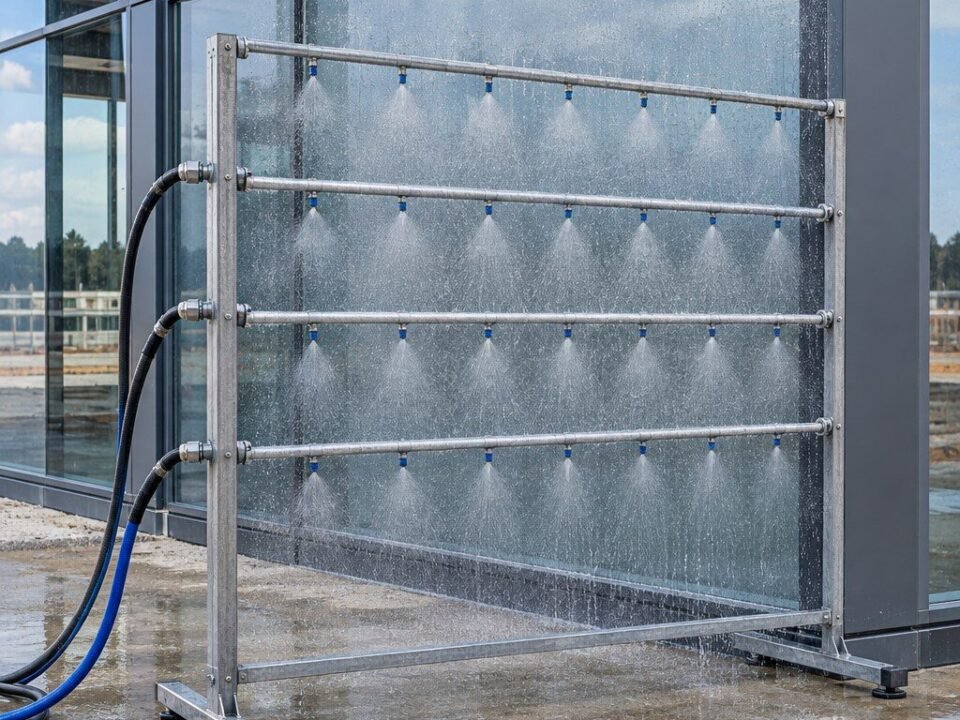
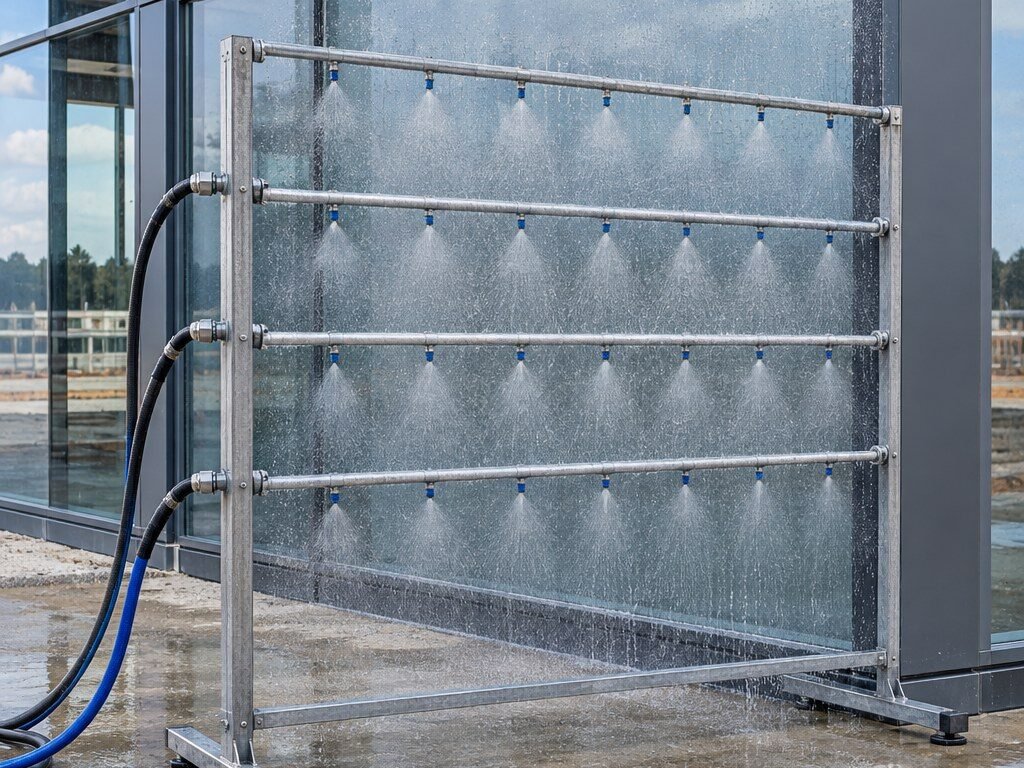
Request the exact designation and edition for each intended test. Similar-sounding methods may measure different phenomena. For example, a field water penetration procedure under a pressure differential should not be confused with a diagnostic water-spray check. Review the project specification and the governing authority’s requirements rather than assuming the newest published edition automatically applies.
2. Can the facility accommodate the actual mock-up?
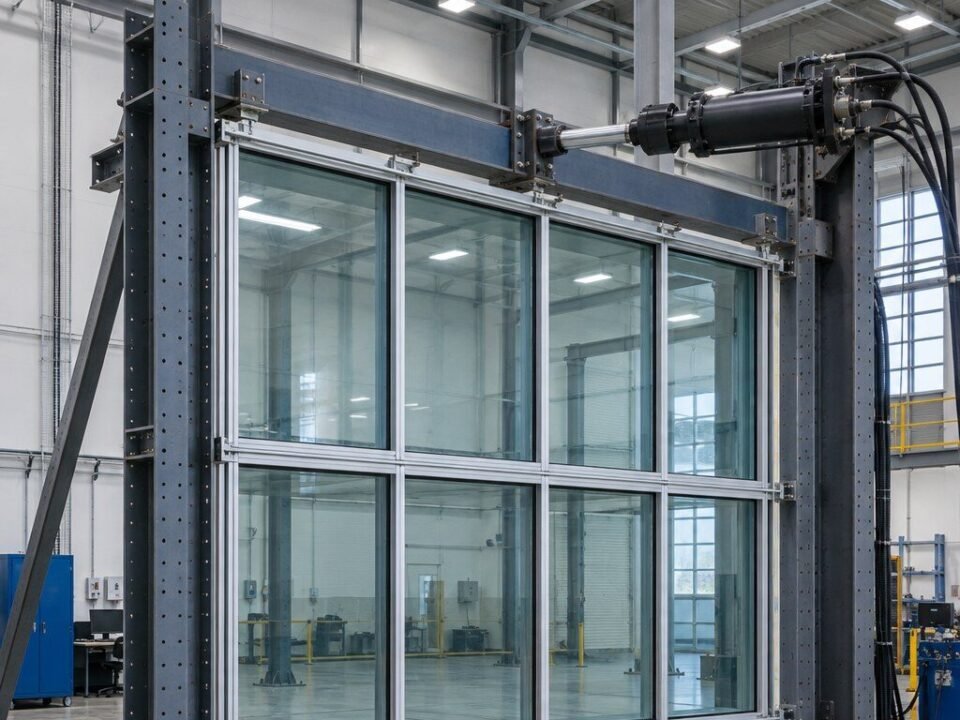
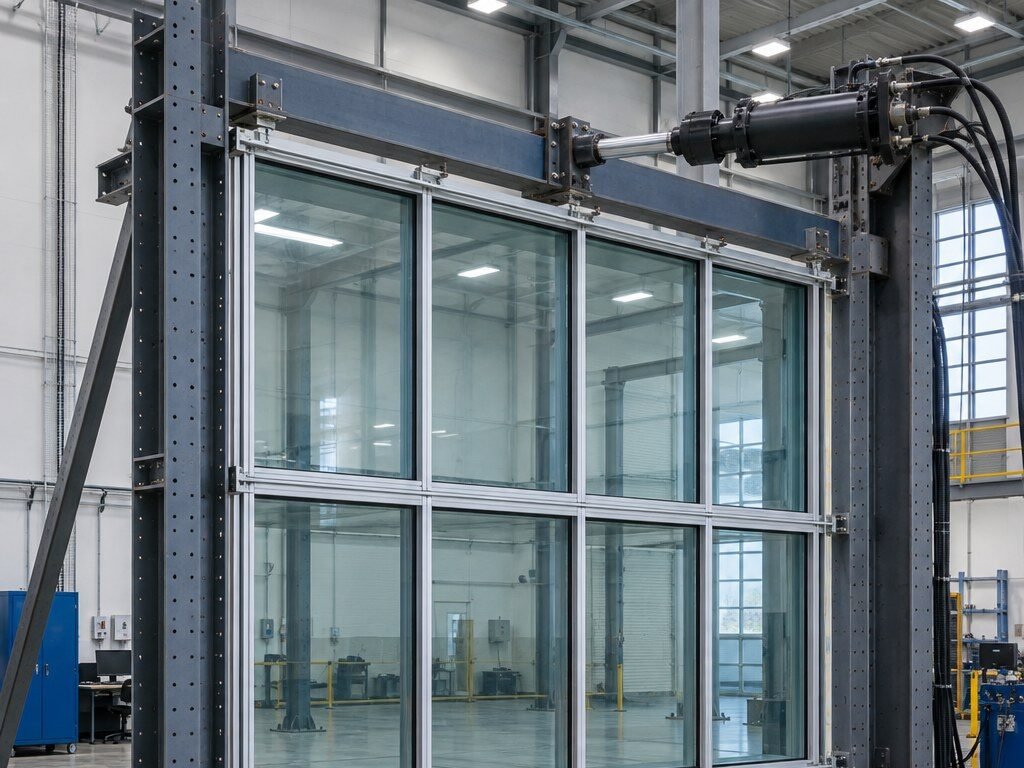
Ask about chamber size, available pressure capacity, anchorage arrangements, specimen access, movement equipment, water delivery and instrumentation. Clarify whether adjacent construction, perimeter seals, corners, slab edges and interfaces are included. A flat sample with idealized supports may be convenient to test but may not address the critical junctions of the real building.
3. Who designs, builds and witnesses the specimen?
Assign responsibilities for shop drawings, fabrication, transport, installation, calibration, witnessing, repairs and retesting. Record whether the mock-up is representative of production materials and installation methods. For a project with delegated façade engineering, the responsible licensed professionals should retain their design responsibilities; the laboratory’s role is to perform and report the agreed tests.
4. What will the report actually contain?
A useful report identifies the specimen, standards and editions, equipment, calibration information, conditions, sequence, observations, measured results, deviations, photographs and limitations. Ask how failed runs, repairs and repeat tests will be distinguished. A short marketing summary or an unrelated product brochure is not a substitute for a traceable test report.
5. How will field work be coordinated?
Field testing needs access, safe work arrangements, a suitable water source, interior observation and a method for documenting pre-existing conditions. Agree on sample selection and corrective-action procedures before crews arrive. Avoid treating a passing result at one location as proof that every installed bay has identical workmanship.
Canadian procurement considerations
The National Research Council publishes the National Building Code of Canada 2025 as a model code and directs users to provincial or territorial officials to determine the applicable regulations. A test plan should therefore reference the adopted local code, contract documents and the relevant test standard editions. Project teams working across provinces should not assume that a report accepted in one jurisdiction will automatically meet another project’s specification.
For procurement, compare proposals on the same written scope. A low price may omit mock-up handling, engineering coordination, witnessing, instrumentation, travel, report revisions or retesting. Conversely, an expensive package may include capabilities the project does not need. Ask for an itemized scope and a realistic schedule showing specimen preparation, testing, deficiency resolution and final reporting.
A practical selection workflow
First, establish the performance questions and the governing documents. Second, shortlist laboratories or field agencies with relevant experience and request evidence of their current scope. Third, review facilities, equipment and specimen constraints with the project team. Fourth, agree on responsibilities, witnessing, reporting and retesting before purchase orders are issued. Finally, review the completed report against the original objectives, including all qualifications and deviations, rather than relying only on a headline pass or fail.
The same discipline applies to a developer comparing vendors, a glazing contractor preparing a mock-up budget or an architect reviewing submittals. Testing is most valuable when the result is tied to a clear decision and the limits of the evidence are understood. For related guidance, see our curtain wall water-testing guide, seismic testing overview and contractor prequalification checklist.
Sources and further reading
FGIA — AAMA Laboratory Accreditation Program; NRC — National Building Code of Canada 2025; FGIA — AAMA 501.1 dynamic water penetration method.
This educational article is not project-specific engineering advice or an endorsement of any testing provider. Verify current standards, accreditation scope and applicable regulatory requirements for each project.