
Three updated façade seismic test documents announced in August 2026 highlight a practical specification challenge: lateral drift, glass fallout and vertical movement are different performance questions. For Canadian curtain wall teams, choosing the right test starts with identifying which movement and failure mode matters.
Why the update matters
Curtain walls are designed to resist environmental loads, but they must also accommodate movement of the structure behind them. During earthquakes, adjacent floors can move relative to one another, imposing racking displacement on glazing, framing, anchors and perimeter seals. A wall that performs well under a static wind-pressure test may not necessarily remain functional after significant inter-storey movement. This is why seismic movement testing deserves a separate place in façade specifications, particularly for projects in regions where seismic demand is consequential.
What FGIA announced in August 2026
On August 18, 2026, the Fenestration and Glazing Industry Alliance (FGIA) announced updated editions of three AAMA documents: AAMA 501.4, AAMA 501.6 and AAMA 501.7. The organization described them as complementary methods addressing different movements or performance outcomes. This is an industry standards development, not an announcement that every Canadian jurisdiction has automatically adopted new code requirements. Project teams should confirm the applicable building code, referenced editions and contractual specifications before selecting a testing program.
AAMA 501.4: horizontal inter-storey drift
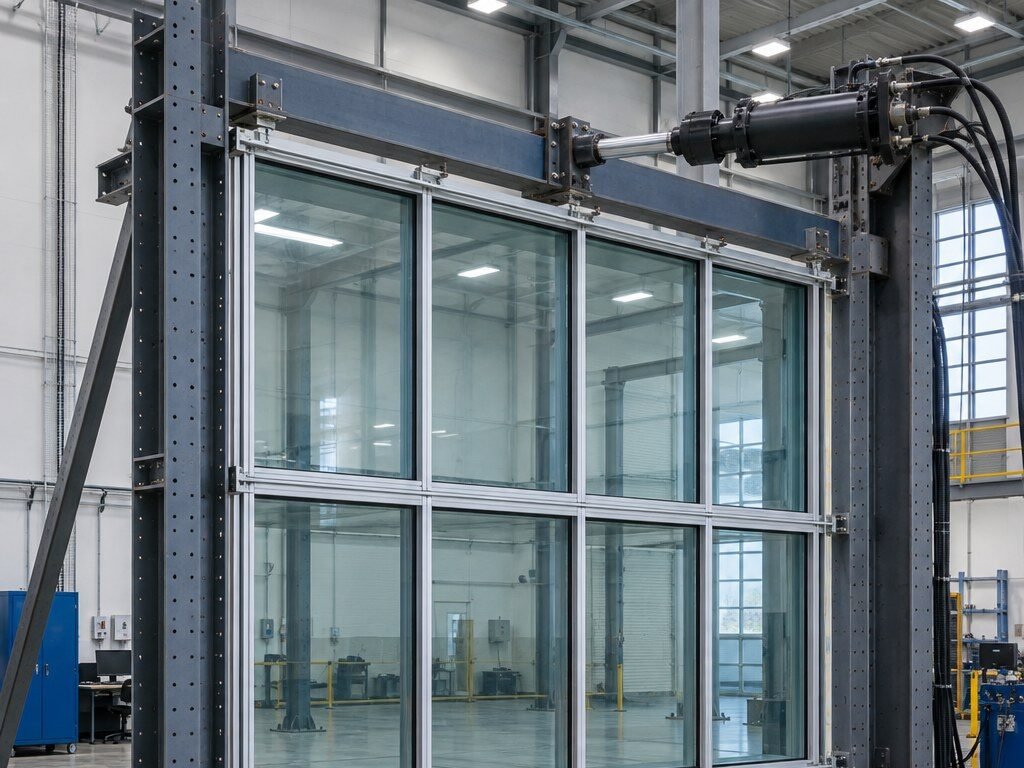
AAMA 501.4 provides a recommended method for evaluating windows, window walls, curtain walls and storefront systems subjected to specified horizontal displacement in the plane of the wall. The focus is controlled lateral racking of an assembly. In practice, this can help reveal distress at glazing pockets, gaskets, framing joints, anchors and seals. The procedure is not interchangeable with a dynamic glass-fallout test. A façade team should identify the required displacement history, the intended performance checks before and after movement, and the project-specific acceptance criteria rather than simply requesting a generic ‘seismic test’.
AAMA 501.6: glass fallout under dynamic movement
AAMA 501.6 addresses the dynamic lateral inter-storey movement associated with glass fallout. Its purpose differs from a serviceability-focused drift evaluation: the concern is the displacement at which representative glass panels may be dislodged from the framing. This distinction matters for public safety and for communication between structural engineers, façade designers, glazing manufacturers and testing laboratories. A system may experience damaged seals or impaired weather performance without glass falling out; conversely, glass retention must not be assumed from an unrelated pressure test. Test reports should clearly state specimen configuration and observed failure modes.
AAMA 501.7: vertical inter-storey movement
Vertical relative movement can arise from structural behavior and imposed displacement scenarios. AAMA 501.7 provides a recommended test method for evaluating wall systems subjected to specified vertical inter-storey displacement. Vertical movement can engage different details than horizontal racking, including stack joints, slip connections, brackets, transoms and clearance around glazing. This method should not be treated as a substitute for either horizontal drift testing or glass-fallout evaluation. The appropriate combination depends on the façade system and the movement demands established for the project.
What to coordinate before testing
A useful testing brief begins with a clearly defined representative assembly. Specify the curtain wall or window-wall configuration, glass construction, anchorage and support conditions, joint geometry, movement allowances and relevant interfaces. The structural design team should provide the applicable movement demands and load combinations; the façade team should explain how the proposed system accommodates them. Confirm whether the program seeks serviceability observations, glass-retention information, or both. Document pre-test conditions, displacement protocol, instrumentation, observations and any subsequent air or water testing. Changes to glass size, bite, framing stiffness or anchor geometry can affect whether a tested assembly represents the project.
Canadian specification implications
For Canadian projects, a standard’s availability does not by itself establish a universal mandatory test requirement. National model codes, provincial or territorial adoption, municipal requirements and the project specification may differ. Testing is also not a replacement for structural analysis or qualified engineering judgment. A procurement team can nevertheless improve clarity by naming the intended test method and edition, the relevant performance objective, and who is responsible for supplying movement demands and reviewing results. This reduces the risk of purchasing a test that answers the wrong technical question.
Practical takeaway
The August 2026 FGIA release is a useful reminder that ‘seismic curtain wall testing’ is not a single test. Horizontal serviceability response, dynamic glass fallout and vertical movement are distinct questions. Architects and developers should ask what outcome they need demonstrated; engineers should establish project-specific demands; manufacturers and laboratories should align specimens and procedures with those demands. For related topics, read our guides to curtain wall wind-load calculations and slab-edge firestopping. This article is general educational information and does not provide project-specific design or professional engineering services.
Sources and further reading
FGIA announcement, August 18, 2026; FGIA standards store (edition selection). Related Curtainwall.ca guides: wind load calculation and slab-edge firestopping.